For years, search engine optimisation focused on helping organisations appear higher in Google. That still remains important, but the way people discover financial expertise is changing.
A potential client may now ask Google, ChatGPT, Perplexity, Gemini or Microsoft Copilot a direct question and receive one consolidated answer rather than a page of links.
For wealth managers, asset managers, private banks, family offices and financial technology companies, this changes what visibility means.
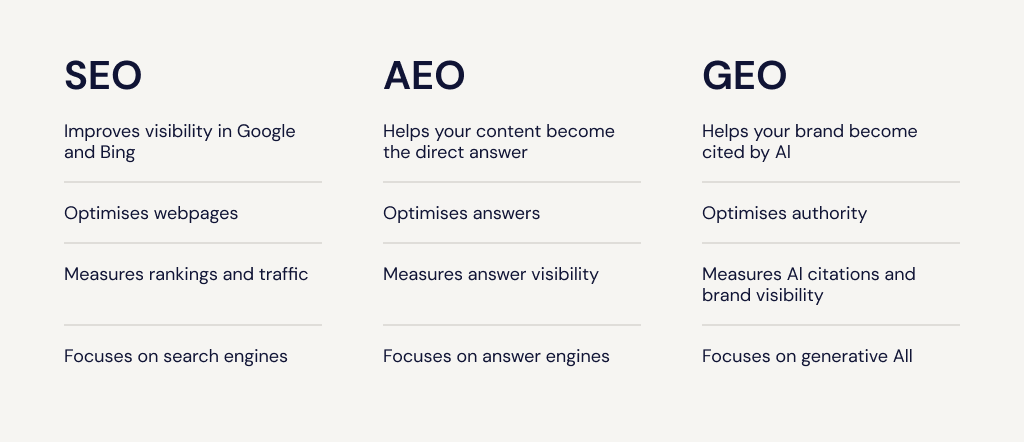
Financial marketers now need to understand three connected disciplines: SEO, AEO and GEO. Let’s get started on what they mean.
SEO stands for search engine optimisation.
Its purpose is to improve how easily a website can be found through traditional search engines such as Google and Bing.
SEO covers areas including:
For financial organisations, SEO is still the credibility baseline. Prospective clients continue to search for company names, compare providers, review credentials and visit websites before making contact. A technically weak or poorly structured site can make credible expertise difficult to find.
SEO helps ensure that the right pages appear when someone searches for a relevant service, question or organisation.
However, a user may now receive an AI-generated summary before reaching the conventional search results. That creates a second challenge: ensuring your content is suitable for direct answers.
AEO stands for answer engine optimisation.
It focuses on making content easier for search and AI-assisted platforms to identify as a clear response to a question.
AEO can support visibility in:
For example, an asset manager may publish a detailed article about private-market investing. Whereas, a conventional SEO strategy might target related search terms and build authority around the page.
An AEO approach would also make sure the article clearly answers specific questions such as:
Useful AEO content typically includes direct introductions, descriptive headings, concise definitions, logical sections and well-written frequently asked questions.
GEO stands for generative engine optimisation.
It focuses on improving the likelihood that a company, expert or piece of content is understood and referenced within answers generated by tools such as ChatGPT, Perplexity, Gemini and Microsoft Copilot.
GEO is not only about whether a website appears in search. It asks broader questions:
Generative AI tools may draw on several public sources when producing an answer. These can include company websites, media coverage, directories, research, executive profiles and third-party references.
A well-produced article can support all three. For example, a wealth manager publishing a guide to cross-border succession planning might:
The same content asset can therefore support discovery, education and authority. This is particularly valuable for financial marketers working with limited time and specialist resources. The answer is not necessarily to publish more but make each piece of content work harder.
Financial services have always been built on trust. People don’t choose a wealth manager, asset manager or technology provider after seeing a single advert. They compare firms, read market commentary, look at who’s behind the business and build confidence before they ever make contact.
AI is quickly becoming part of that research process. Instead of searching through pages of results, a family office might ask ChatGPT which platforms support complex reporting. An adviser may look for asset managers with specialist retirement-income expertise, while an institutional investor could ask for providers operating in a particular market.
The companies that appear in those answers have an immediate advantage. They’re introduced early in the buying journey, often before a prospect has even visited a website.
Source: HSBC, ‘The Trust Threshold’ Report
1. The first priority is clarity.
Your website should define what the organisation does, who it serves, where it operates and what makes its expertise relevant. That description should remain consistent across service pages, executive biographies and external profiles.
2. The second is useful content.
Financial companies often publish credible material that is too broad, difficult to navigate or hidden inside lengthy PDFs. Important research should be supported by accessible web pages, clear summaries and focused answers to client questions.
3. The third is authority.
Generative AI platforms need signals that help them distinguish genuine expertise from promotional claims. Named experts, original research, evidence-led commentary, media references and credible external citations all strengthen that picture.
4. The fourth is technical accessibility.
Search engines and AI systems need to discover and interpret important pages. Indexing controls, robots.txt instructions, sitemaps, canonical tags, structured data and internal links should all be reviewed.
5. Finally, marketers need a measurable baseline.
That means checking where the organisation appears across traditional search and AI platforms, how it is described and which competitors are gaining visibility.
Traditional SEO metrics such as rankings, organic traffic and conversions are still important, but AI visibility introduces a different set of questions.
Are you appearing in AI-generated answers? Is your company being described accurately? Are the right pages being cited? And when someone asks about your area of expertise, are you being mentioned before your competitors?
These are the signals that help build a clearer picture of your visibility across search and AI platforms.
It’s also worth remembering that there isn’t a single definitive answer. Ask the same question in ChatGPT, Perplexity or Gemini and the response may vary depending on the platform, wording or even the location of the user.
That’s why measuring AI visibility isn’t about checking one prompt once and assuming the job is done. The best approach is to test a consistent set of questions over time, benchmark the results and look for trends. That way, AI visibility becomes something you can monitor, improve and measure- just like traditional SEO.
Strong search visibility now depends on technical performance, clear content, credible expertise and a consistent digital presence across owned and external channels.The organisations that understand this early will be better positioned to shape how clients discover and evaluate them.
WAM Digital helps wealth and asset management companies assess and improve visibility across SEO, AEO and GEO.
Our Search Visibility Audit benchmarks your current position, identifies competitor gaps and provides a practical roadmap for improvement.
Yes. SEO remains the foundation of online visibility. Strong technical SEO makes it easier for search engines and AI platforms to discover and understand your content.
SEO focuses on helping pages rank in search engines. AEO focuses on structuring content so it can become the direct answer to a user’s question.
Generative Engine Optimisation (GEO) helps organisations improve the likelihood of being recognised, referenced and cited by AI platforms such as ChatGPT, Perplexity, Gemini and Microsoft Copilot.
Yes. SEO, AEO and GEO work together. Technical SEO provides the foundation, AEO improves answer visibility, and GEO strengthens authority across AI-generated responses.
The best place to start is with an AI visibility audit that benchmarks how your organisation appears across Google AI Overviews, ChatGPT, Perplexity, Gemini and Microsoft Copilot.