
Financial firms invest heavily in expertise. That expertise might sit with investment specialists, advisers who have spent years working with a particular type of client, or research teams producing detailed views on markets and portfolios. Inside the business, there is usually a very clear understanding of what the firm does well and who it is best placed to serve.
From the outside, that picture can be much less obvious. Ask an AI tool a relatively straightforward question about a wealth manager, asset manager or private bank and the description may be broad, incomplete or based on information that is no longer current.
This matters because AI is becoming part of the research process.
For financial marketers, the question is therefore quite simple: when someone asks AI about your firm, has your digital presence given it enough information to understand you properly?
Source: HSBC, The Trust Threshold, 2026. Research conducted by Ipsos
Within a financial firm, a lot of context is taken for granted. Your team knows which clients you work with, where you operate, which capabilities genuinely differentiate the business and which experts are responsible for them.
AI does not begin with that institutional knowledge. It has to build a picture from information available across your website and other public sources. That might include service pages, research, executive biographies, LinkedIn profiles, media coverage, directories and regulatory or third-party references.
When those sources are clear and broadly consistent, there is more useful context to work with. When information is vague, fragmented or contradictory, there is more room for an incomplete interpretation.
This is particularly important in financial services because seemingly small details can change the meaning of a statement. Saying that a firm provides “private-market investment solutions” leaves several questions unanswered. Which private markets? For whom? Is the firm advising, managing assets directly or selecting external managers? Are those services available in every market in which the company operates?
There is another reason clarity matters: financial questions can be difficult even for sophisticated AI systems.
The IMF has highlighted hallucination as a particular risk for generative AI in finance, noting that models can produce plausible but incorrect information and that errors in areas such as risk assessment or customer-facing financial services can have significant consequences.
More recent benchmarking shows how difficult complex financial research remains. The 2025 Finance Agent Benchmark contains 537 expert-authored questions spanning nine types of real-world financial research tasks. Even the best-performing model in the researchers’ evaluation achieved 46.8% accuracy. This is a deliberately difficult benchmark rather than a measure of everyday AI search, but it demonstrates why complex financial context should not be taken for granted.
For financial firms, that makes context especially important. Client type, jurisdiction, eligibility and the scope of a service should be clear wherever they materially affect what the information means.
Consider a typical annual investment outlook. A firm might spend months producing 40 pages of research, forecasts, charts and commentary from senior investment professionals. It is then uploaded to the website with a short introduction and a “Download PDF” button.
The report is valuable, but much of its thinking is now concentrated in one format. Someone searching for a specific issue discussed on page 27 may never encounter it.
Rather than producing another completely separate piece of content, there is an opportunity to make that existing expertise work harder. One substantial report could support a web article exploring its central argument, an FAQ addressing investor questions, an executive viewpoint, individual charts with written interpretation and shorter content for social or client communications.
This is where SEO, AEO and GEO connect in a useful way. SEO helps relevant information become discoverable through conventional search. AEO considers how clearly content responds to specific questions. GEO looks more broadly at how a firm’s information and expertise can be understood and referenced in generative-AI environments. Rather than treating these as three separate marketing exercises, it is more useful to think about the journey between being found, being understood and being represented accurately.
Want to find out more about how this works? Book a 30 minute Search Visibility Assessment today and get started.
A firm may also have several slightly different versions of itself online. Its website describes operations in five markets, while an old executive biography mentions three. LinkedIn carries previous positioning and an external directory still uses a company description written before a rebrand.
Individually, those inconsistencies may not seem particularly important. Collectively, they make the picture less clear.
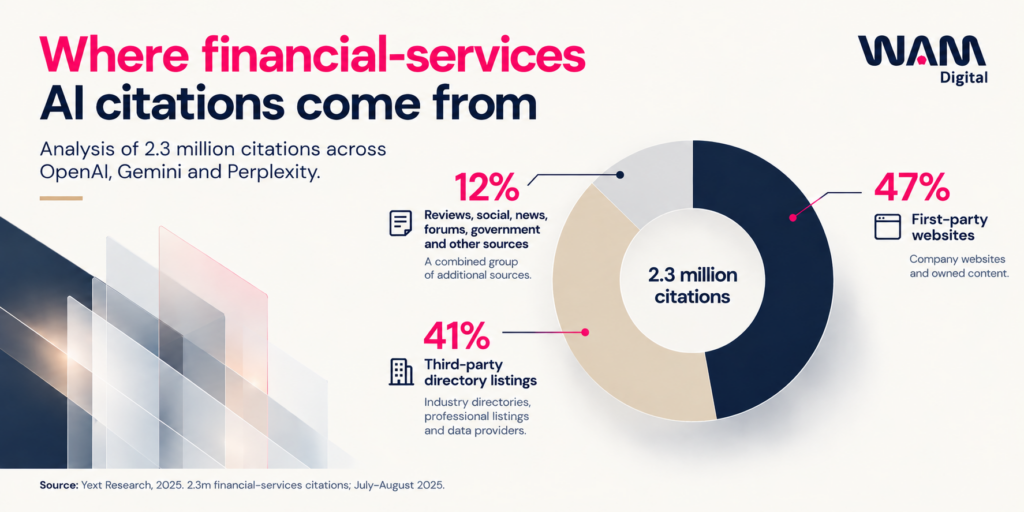
Yext’s 2025 study analysed approximately 2.3 million citations from finance-related AI responses across OpenAI, Gemini and Perplexity. In its dataset, 47% came from first-party websites and 41% from third-party directory listings. The study was conducted using Yext clients and prospects over a two-month period, so its findings should not be treated as a universal formula for every financial company or AI query. They do, however, show how significant brand-owned and brand-managed information can be within AI citation patterns.
Make sure your website clearly answers the questions prospective clients are asking and that the information is consistent across your digital presence.
Review your existing website and digital presence to identify gaps, inconsistencies and unclear information before creating more content.
No firm can dictate exactly what ChatGPT, Gemini, Perplexity or another independent AI platform will say about it. Models, sources and responses change, and credible SEO, AEO and GEO work should not be built around promises of guaranteed citations.
What a firm can improve is the information those systems and prospective clients have to work with. Clear positioning, useful answers, consistent company information, visible expertise and well-supported claims make the business easier to understand wherever someone encounters it.
That is why the more useful question is not, “How do we make AI mention our firm?” It is whether you have given people, search engines and AI platforms enough clear, credible information to understand why your firm is relevant.
Why does AI sometimes describe financial firms incorrectly?
AI systems build answers from the information and sources available to them. When company information is unclear, inconsistent, outdated or lacking context, the resulting description may also be incomplete.
Can a financial firm control what ChatGPT or Gemini says about it?
No. Firms cannot control the output of independent AI platforms. They can, however, improve the accuracy, clarity and consistency of the information they publish and manage.
Does appearing in Google mean a firm will appear in AI answers?
Not necessarily. Traditional search and generative AI use information differently, which is one reason SEO, AEO and GEO need to be considered together rather than interchangeably.
Should financial firms publish more content to improve AI visibility?
Not automatically. Improving existing service pages, research, biographies and company information may be a better starting point than simply increasing content volume.
How should a financial firm assess its AI visibility?
Start with real questions your clients and prospects are likely to ask. Test them across multiple AI platforms, record whether and how the firm appears, examine the sources cited and look for recurring gaps or inaccuracies.